

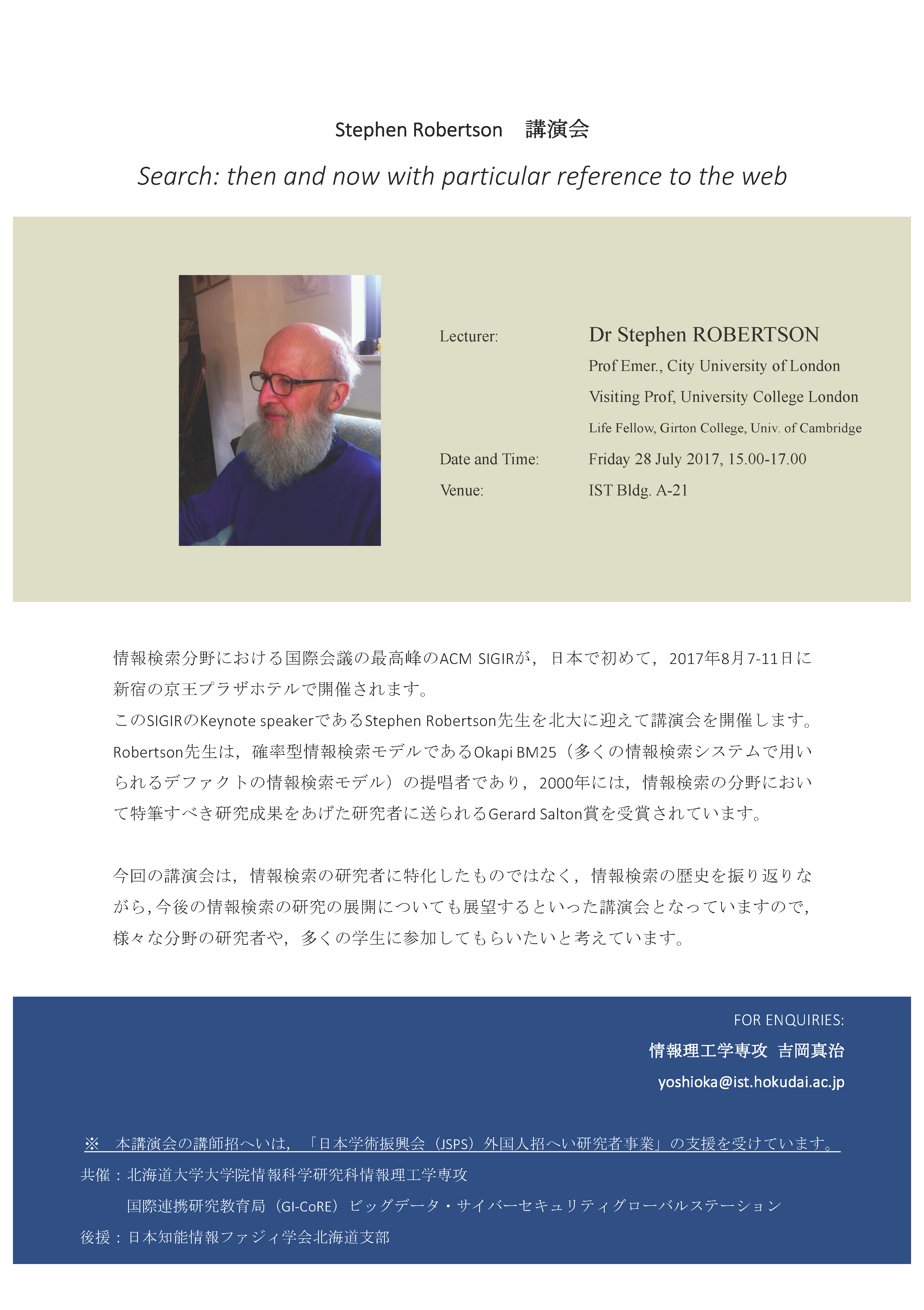
Stephen E. Robertson Presents:
Search: then and now with particular reference to the web
July 28, 2017 at 15:00 for 2 hrs
Roon A21, Graduation School of Information Science and Technology, Hokkaido University
Search: then and now with particular reference to the web
July 28, 2017 at 15:00 for 2 hrs
Roon A21, Graduation School of Information Science and Technology, Hokkaido University
Organized by:
Graduation School of Information Science and Technology (IST)
Global Station for Big Data and Cybersecurity (GSB)
Abstract
Nowadays, we take web search engines for granted. For many people, their favourite
search engine (Google or some other) is their primary or even sole entry-point to
the web. Not only that – it also, in some sense, is the web: what you find by
searching is indistinguishable, or at least not distingushed, from the search engine
itself. In this talk, I will attempt to chart how we have reached this point. To
start with, I will go back before search engines or the web even existed –
indeed, before computers existed. Card catalogues in libraries, printed indexes,
punched cards (some mechanically sorted, some used purely manually) have all played
a role in how we see the search task. In the computer era, but before the internet
or the web, we started exploring the idea of computer searching, particularly in
relation to abstracts of scientific papers. When the web came along, web search
engines began to emerge, but they took a little longer to become mainstream, and
then to discover a viable business model. But as both these things happened, a
rather extraordinary series of feedback loops began to shape and mould the search
experience. The most obvious loop is that between the search engine and the
population of searchers. The way search engines work, as seen by us the users, has
had a profound effect on our notion of what search is and how we might use it; and
on the other hand, the search engines have responded to and learnt from their users,
to an extraordinary extent. Other feedback loops can be indentified, one involving
website designers and another advertisers, each interacting with (influencing and
being influenced by) the search engines. The consequence is that the modern search
engine feels a thousand miles or years removed from its library science forebears. I
will end with a novel way to think about what web search engines do.
Biography
“Stephen Robertson has been researching in the field of information retrieval
since 1968, and has been publishing since 1969. He is currently retired from
full-time work, but remains Professor Emeritus at City University of London,
Visiting Professor at University College London, and a Life Fellow at Girton College
Cambridge. His previous employment includes five years at University College, twenty
at City University, and fifteen at Microsoft Research Cambridge. In 1981 he received
a Fulbright Award and spent some months at the University of California Berkeley. He
won the Gerard Salton Award in 2000 and the Strix Award in 1998; he is an ACM
Fellow. His main areas of research have been the evaluation of IR systems,
particularly evaluation metrics, and probabilistic models. The latter led him in the
early 1990s to invent the BM25 ranking function, which remains a benchmark for
effective ranking of search results.” (adapted from SIGIR 2017’s
website)
Acknowledgments
This talk is organized in cooperation with the Japan Society for Fuzzy Theory and Intelligent Informatics’s Hokkaido branch, and supported by JSPS under “Invitation Fellowships for Research in Japan.”
Contact
Masaharu Yoshioka (IST/GSB, Hokkaido University)
E-mail: yoshioka@ist.hokudai.ac.jp