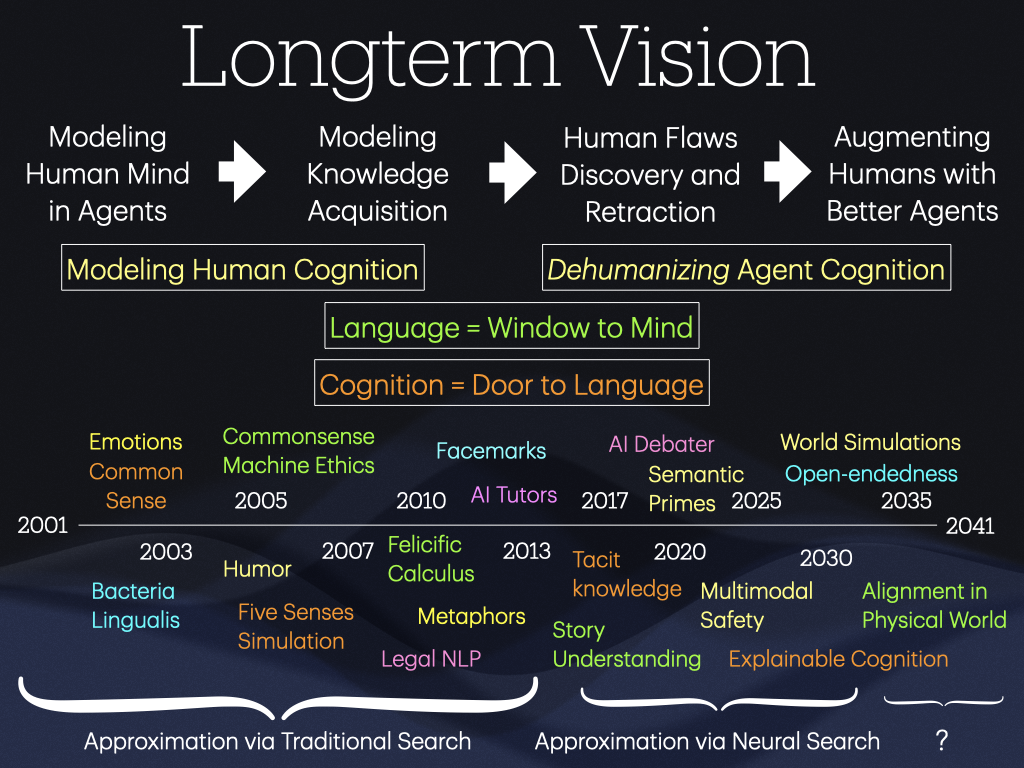
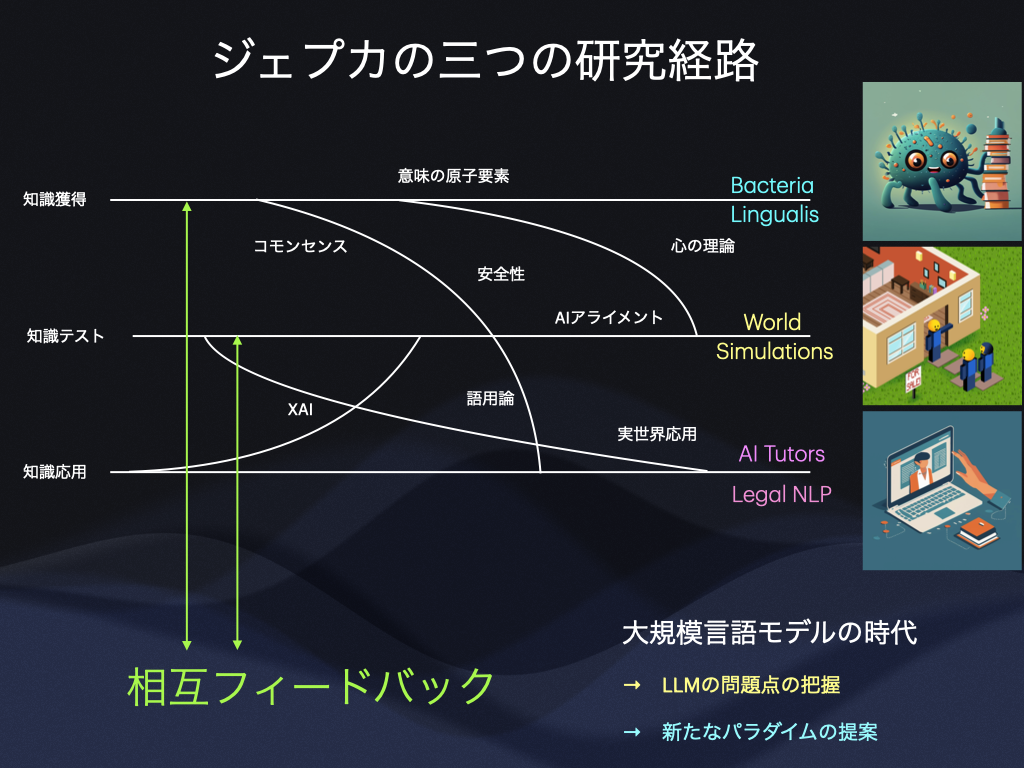
Understanding language is the key for accessing the vast knowledge humans have gathered for ages. But we understand text because we also see, feel and sense the world around us. A language possesses power not only to convey the wisdom we and our ancestors accumulated, it can be a natural and powerful mean to share and confront old knowledge with newly discovered one, also by machines. The twenty-first century is about combining and applying methods across various fields, modalities and tasks. Natural Language Processing has a yet underrated capability to make sense of the constantly growing enormous data which is already impossible to process by a human mind. Machine Learning gives us ways to find patterns, but we are still the ones who have to interpret their meaning. This is why I'm interested in more general AI (AGI) which is supposed to reason about our world on our terms, learn how to learn and explain what it learned. Although Large Language Models showed us the power of big data and hardware, they are far from sufficient and reliable. I believe that we need a paradigm shift in how the knowledge is accumulated and learned - as a nativist interested in human-aligned machines, I seek for novel build-in cognitive mechanisms that have to be decided before learning starts. Recently my group tries to simulate real-world situations closing the gap between text-image analysis to physical world where multiple agents live their lives with a machine (or more machines) to observe AI's behavior - how it deals with tiny moral dilemmas or potential threats in both physical and verbal actions of co-habitants. I'm involved in many projects and topics already, but I'm open to starting new ones, especially across various disciplines. Some of the examples of the current topics are briefly described below.
Common Sense
Common Sense Knowledge is required for an autonomous AI to reason properly about our world. Called the Holy Grail of AI, common sense is recently told to be "solved" by LLMs. But if you go into more "tacit" knowledge with us, you'll see that acquiring it beyond what can be inferred from text is still challenging.
Artificial Empathy
Understanding what a human being feels is probably the most important skill for an artificial agent. We extend emotion recognition by employing additional contextual factors as time or probability of a positive or negative state continuity. Large scale datasets are used to calculate how strong or certain are the emotional changes in humans.
Machine Ethics
From 2005 we have been developing an automatic moral decision making agent by combining common sense and affect recognition. Our original commonsense ethics approach does not rely on any particular school of thought, it observes the polarity change by processing vast numbers of cases.
AI for Well-being
Machine Intelligence has a potential not only to help us in short-term tasks, but also to influence our thinking in a long run. Scrupulously analyzed scientific data can correct errors of common sense, show us negative outcomes of cognitive biases, translate and explain what people on the other side of the world or outside your filter bubble think.
Dialog Systems
Our artificial assistants can be much more than question-answering one-utterance partners. We aim at conversational systems which can discuss with us, teach us what we are wrong about, make us motivated, help us stay positive and focused, keep us informed, entertained and emotionally touched.
Figurative Language
Artificial creativity is needed not only for coming up with new ideas helping people to discover new patterns. It is also about finding novel ways of expressing and explaining. We work on metaphor understanding and generation, machine-created poetry and irony to allow machines to improve and enrich their communication abilities.
Humor Processing
Humor is told to be a display of human intelligence but computers are not too good with recognizing and generating it. In our research we try to reach beyond the popular puns and word-plays by implementing more sophisticated language understanding algorithms.
Cognitive Architectures
Our novel approach to AGI-level holistic cognitive architectures is to integrate lifelong knowledge acquisition in KABURA by crawler-like multi-agent entities called Bacteria Lingualis. Confronting their findings from different data sources in different languages is the key for wider context understanding.
My Group Members
Current Members
- Atsuhiro Ihara
- Jin Hosono
- Don Divin Anemeta
- Waiyan Hein
- Takuto Sato
- Asato Yamada
- Asa Yokoyama
- Binghao Wang
- Shion Kubo
- Kai Morishita
- Kazune Yanagimachi
Previous Members
- Zong-Ye Li
- Akihiko Obayashi
- Ryoma Shinto
- Ryūta Aoyagi
- Masashi Takeshita
- Kei Okada
- Ryo Hashimoto
- Arisa Abe
- Huizhong Ji
- Joanna Szwoch
- Xiaodong Liu
- Yiyang Zhang
- Dusan Radisavljevic
- Yuki Katsumata
- Kaiya Sasaki
- Hiromichi Kameya
- Kazuki Yano
- Daiki Masuda
- Mizuki Yoshii
- Masaki Sakata
- Aitaro Yamamoto
- Bartosz Ziolko
- Da Li
- Daiki Shirafuji
- Yuki Urabe
- Mateusz Babieno
- Saori Hayashi
- Patrycja Swieczkowska
- Sho Takishita
- Yoshifumi Fukuda
- Yue Wang
- Maria Skeppstedt
- Seiya Shudo
- Shuto Fukuda
- Radoslaw Komuda
- Keita Mitsuhashi
- Yuki Konno
- Daniel Harborne
- Michal Mazur
- Marek Krawczyk
- Ikumi Inoue
- Soichi Tanaka
- Shohei Kitahara
- Taku Nakamura
- Anna Gschwendtner
- Joelle Vitzikam
- Tadashi Tanaka
- Kohei Hara
- Satsuna Denzumi
- Kohei Matsumoto
- Urszula Jagla
- Austin Clapp
- Takuya Kamiyama
- Denis Kiselev
- Shiho Kitajima
- Michal Sylwester
- Yuusuke Amaya
- Mitsuru Takizawa
- Krzysztof Karolczak
- Svetoslav Dankov
- Hajime Wakahara
- Magnus Ahltorp
- Dai Hasegawa
- Keisuke Takagi
- Ryoichi Chikamura
- Takuya Emori
- Koichi Muramoto
- Pawel Bylica
- Tyson Roberts
- Motoyasu Fujita
- Pawel Dybala
- Michal Ptaszynski
- Hugues Baudrillart
- Mahfoud Bouzidi
- Amrane Chabane
- Kenta Imai
- Wenhan Shi
- Jacek Maciejewski
- Shinsuke Higuchi
- Yudai Kitano
- Ge Yali